New 2026 EV Road Tax Structure
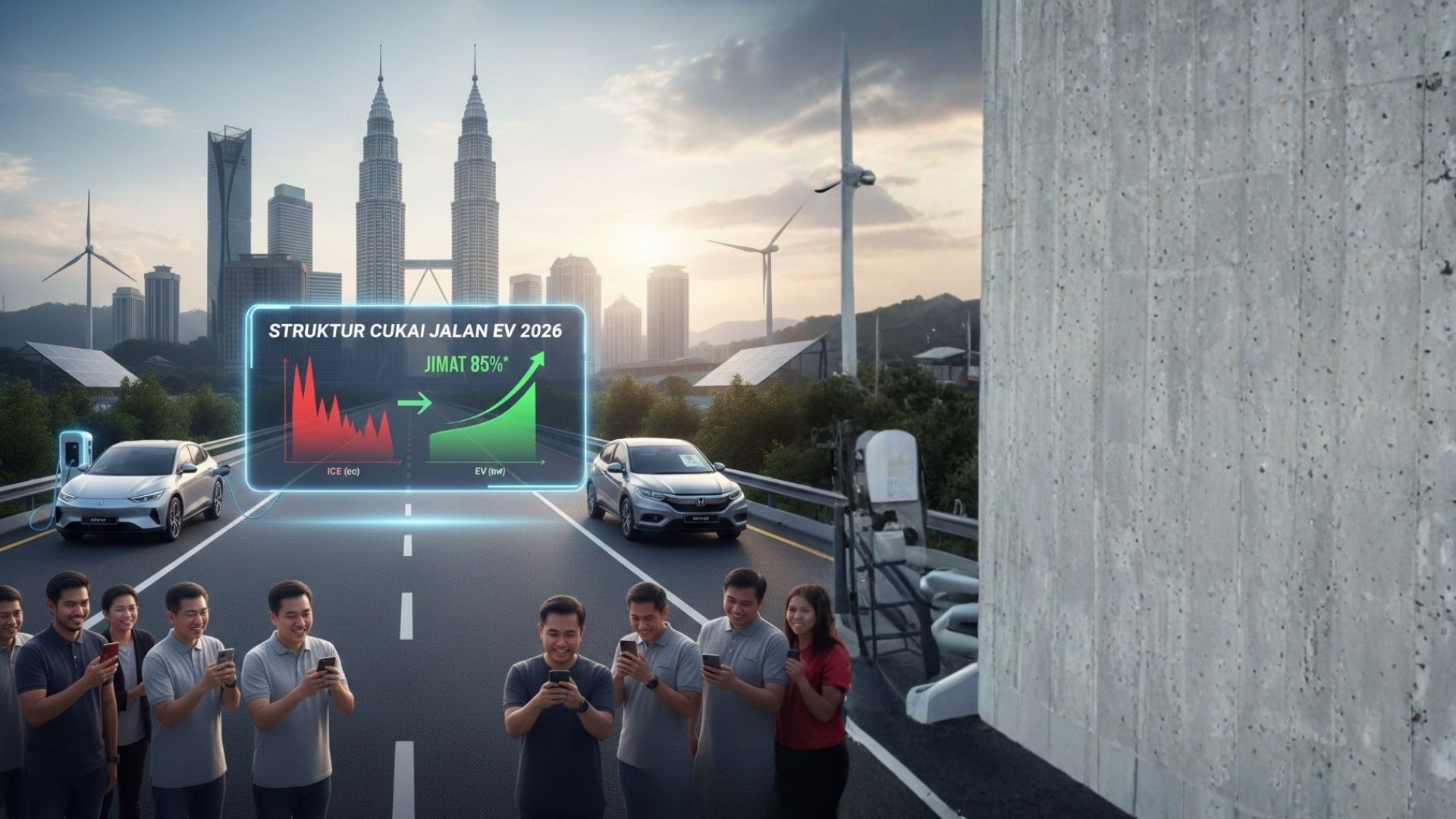
New Road Tax Structure: A Power-Based (kW) System for EVs
The transition toward sustainable mobility in Malaysia has reached a pivotal juncture with the official implementation of the new power-based (kW) road tax structure for electric vehicles (EVs). For years, prospective EV owners expressed significant apprehension regarding the "fiscal cliff" that would occur once the initial tax exemptions expired. The primary pain point centered on whether high-performance electric motors would be penalized under an archaic displacement-based taxation model that never truly fit the profile of zero-emission technology. As of January 1, 2026, the Malaysian government has effectively addressed these concerns by introducing a framework that, while no longer free, remains significantly cheaper than traditional road tax for internal combustion engine (ICE) vehicles.1 This structural shift is designed to ensure that the adoption of green technology remains financially viable for the masses while contributing proportionately to national revenue.
The Evolution of Automotive Taxation: From Cubic Capacity to Kilowatts
The historical context of vehicle taxation in Malaysia was fundamentally rooted in the physical displacement of internal combustion engines, measured in cubic centimeters (cc). This model was an effective proxy for vehicle size, price, and environmental impact for nearly a century. However, the emergence of battery electric vehicles (BEVs) and fuel cell electric vehicles (FCEVs) rendered the "cc" metric obsolete, as electric motors do not possess engine displacement.
In the early stages of EV adoption, the Malaysian government offered a complete road tax holiday from January 1, 2022, to December 31, 2025, to catalyze market interest.3 As this "tax holiday" concludes, the Ministry of Transport (MOT) has launched a revised power-based system. This new structure is not a return to the pre-2022 formula, which many considered punitive, but rather a rationalized, progressive model based on total motor power output measured in kilowatts (kW).1 The government's core objective was to create a transparent system that aligns vehicle performance with tax liability without overburdening the average consumer. On average, the 2026 rates are 85% lower than the equivalent ICE taxation rates seen prior to the incentive period, representing a significant long-term saving for early adopters and new buyers alike.
The Technical Mechanism of the kW-Based Tiers
The 2026 road tax system is structured into 11 distinct power bands, each covering a range of 100,000 watts (100 kW).7Within these bands, the tax is calculated using a combination of a fixed base rate and a progressive increment for every 9.99 kW (9,999-watt) block.5 This granular approach prevents sharp jumps in tax liability, ensuring that a minor increase in motor performance does not lead to a disproportionately high tax bill.
The mathematical formula for calculating the annual fee for a vehicle within a specific band follows this logic:
Total Road Tax = Base Rate + ( Number of 9.99kW Block x Increment )
For example, a vehicle producing 150 kW falls into the second band (100.1 kW to 210 kW). It starts with a base rate of RM80 and adds increments for the power exceeding the base of that band.7 This systematic transparency allows manufacturers and fleet managers to project total cost of ownership (TCO) with high accuracy, facilitating better long-term financial planning for both individual households and corporate entities.
Comprehensive Breakdown of the 2026 Power Bands and Fees
The Ministry of Transport has finalized the bands to cover everything from entry-level urban hatchbacks to high-performance electric supercars. The following table illustrates the core structure that applies to both individual and company-registered private saloons in Peninsular Malaysia:
| Power Band | Motor Output Range (kW) | Base Rate (RM) | Increment per 9.99 kW Block (RM) | Max Tax for Band (RM) |
| Band 1 | 0.001 – 100.0 | 20.00 | 10.00 | 70.00 |
| Band 2 | 100.1 – 210.0 | 80.00 | 20.00 | 280.00 |
| Band 3 | 210.1 – 310.0 | 305.00 | 30.00 | 575.00 |
| Band 4 | 310.1 – 410.0 | 615.00 | 50.00 | 1,065.00 |
| Band 5 | 410.1 – 510.0 | 1,140.00 | 100.00 | 2,040.00 |
| Band 6 | 510.1 – 610.0 | 2,165.00 | 150.00 | 3,515.00 |
| Band 7 | 610.1 – 710.0 | 3,690.00 | 200.00 | 5,490.00 |
| Band 8 | 710.1 – 810.0 | 5,715.00 | 250.00 | 7,965.00 |
| Band 9 | 810.1 – 910.0 | 8,240.00 | 300.00 | 10,940.00 |
| Band 10 | 910.1 – 1,010.0 | 11,265.00 | 350.00 | 14,415.00 |
| Band 11 | 1,010.1 and above | 20,000.00 | N/A | 20,000.00 |
The implications of this table are profound. For a mainstream EV owner, the annual road tax will rarely exceed RM300, keeping the recurring cost of ownership competitive with—or lower than—popular petrol-powered models.1Conversely, the RM20,000 cap for Band 11 ensures that even the most extreme hypercars have a defined fiscal ceiling, providing predictability for the luxury segment.
Impact on Popular EV Models in the Malaysian Market
To understand the practical application of these rates, one must look at the specific models currently dominating the Malaysian roads. The 2026 structure favors the mid-range "sweet spot" of the market, where vehicles typically offer between 100 kW and 200 kW of power.
| Car Brand | Model Variant | Power Output (kW) | 2026 Road Tax (RM) |
| BYD | Dolphin Standard Range | 70 | 40.00 |
| BYD | Atto 3 Extended Range | 150 | 160.00 |
| Tesla | Model 3 RWD | 208 | 280.00 |
| Tesla | Model Y Long Range AWD | 378 | 915.00 |
| Proton | eMas 7 (Standard/Premium) | 160 | 200.00 |
| Volvo | XC40 Recharge | 300 | 575.00 |
| Porsche | Taycan Turbo S | 560 | 2,100.00 |
| Lotus | Eletre R | 675 | 4,290.00 |
As the data suggests, a high-volume model like the BYD Atto 3 will cost only RM160 per year—roughly the same as a traditional 1.5-liter or 1.6-liter ICE vehicle.10 For owners of the Proton eMas 7, the RM200 annual fee is a manageable sum that reflects the car's position as a premium national electric vehicle.1 These figures represent a massive reduction from the pre-2022 rates; for instance, the Tesla Model Y would have cost nearly RM2,600 annually under the old system, compared to just RM305 today.
Comparative Economic Analysis: EV vs. ICE Road Tax
A critical driver of the new structure is the "Bargain in Context" argument. While EV owners must now pay a fee where previously there was none, the absolute cost remains highly favorable when compared to comparable internal combustion engine vehicles.
Mass-Market SUV and Sedan Comparisons
For many Malaysians, the choice often comes down to a choice between a 1.5-liter turbocharged ICE vehicle and a mid-range EV. In the 1.5-liter segment, road tax is typically around RM90 for popular models like the Honda HR-V or the Proton X50.10 While the RM160 road tax for an equivalent EV like the BYD Atto 3 is slightly higher, the EV compensates with significantly lower maintenance and fuel costs.
When moving into the executive and luxury segments, the EV advantage becomes undeniable. A traditional 2.5-liter petrol sedan like the Toyota Camry incurs a road tax of over RM800.1 An equivalent electric executive sedan like the BMW i5 eDrive40 (250 kW), which offers superior performance and acceleration, will only cost RM395 under the 2026 rates.
The Performance Advantage: A Case Study in Luxury
The most stark disparity is found at the highest levels of performance. The Rolls-Royce Spectre, a pinnacle of electric luxury, outputs approximately 430 kW. Under the new 2026 structure, its annual road tax is RM1,240.12 In contrast, a petrol-powered Rolls-Royce with a traditional 6.75-liter V12 engine requires an annual road tax payment of RM19,005 in Peninsular Malaysia.12 This means the electric owner pays less than 7% of the tax required for the petrol version, despite the vehicles occupying the same luxury tier. Similarly, the Porsche Taycan Turbo S costs RM2,100 to tax, whereas an ICE car with equivalent performance (typically a 4.0-liter or 5.0-liter engine) would cost upwards of RM6,000 to RM16,000 depending on the specific displacement.
Operational Roadmap: Renewing Road Tax in the Digital Era
The introduction of the 2026 road tax structure is deeply integrated with the Malaysian government’s digitalization initiatives. The Road Transport Department (JPJ) has largely transitioned to the MyJPJ ecosystem, which facilitates the issuance of digital road tax (e-LKM) and digital driving licenses (e-LMM).
Step-by-Step Guide to EV Road Tax Renewal
For EV owners in 2026, the renewal process is designed to be entirely contactless and accessible through a smartphone. It is essential to note that road tax can be renewed up to two months before its expiry date.11
Insurance Renewal: The JPJ system requires an active motor insurance policy before it will allow road tax issuance. Owners must first renew their insurance through an agent, an insurer's website, or a platform like Motorist.my.
App Access: Launch the MyJPJ app and navigate to the "Profile" icon at the bottom.
Vehicle Selection: Under the "Motor Vehicle License" tab, select the specific vehicle registration number for the EV being renewed.
Payment and Duration: Select the desired renewal duration (typically 6 or 12 months) and the preferred payment method (Credit/Debit card or FPX).
Digital Confirmation: Once the transaction is successful, the digital road tax status will update within the app. It is no longer mandatory to display a physical sticker on the windscreen for private vehicles.
Managing Technical Glitches and Sync Delays
The transition to a digital-first system has encountered occasional technical hurdles. In late 2025, some JPJ systems experienced a glitch that prematurely charged EV road tax at rates that did not align with the 2024 announcements, appearing to apply a partial reversion to the old, pre-2022 framework.2 While these issues are typically rectified quickly by JPJ's technical teams, owners are advised to keep their digital or physical receipts of renewal for at least 24 to 48 hours until the digital record in the MyJPJ app reflects an "Active" status.
If a road tax status appears as "Inactive" despite successful payment, it is often due to a synchronization lag between the insurance provider and the JPJ database. This processing time usually takes 1 to 3 working days.19 To minimize such risks, owners should ensure their insurance policy start date has already commenced before attempting the road tax renewal.
Infrastructure and Safety: Home Charging Guidelines
The viability of EV ownership in 2026 is inextricably linked to home charging infrastructure. While the road tax remains affordable, the cost and safety of home charging are critical components of the ownership equation. The Energy Commission (Suruhanjaya Tenaga) has issued strict guidelines (GP/ST/No. 54/2025) regarding the installation of Electric Vehicle Charging Systems (EVCS).
Electrical Requirements for Landed and High-Rise Homes
Landed home owners must distinguish between single-phase and three-phase power supplies. A standard single-phase supply is generally limited to 7 kW chargers, whereas faster 11 kW or 22 kW chargers require a three-phase upgrade and Tenaga Nasional Berhad (TNB) approval.
For residents in high-rise condominiums or apartments, the process is more complex. Written consent must be obtained from the Joint Management Body (JMB) or Management Corporation (MC) before any installation can occur. Furthermore, all home installations must include dedicated circuits and Residual Current Devices (RCDs) with an operating current of less than 30 mA to mitigate fire and leakage risks.6 Utilizing a SIRIM-certified charger is non-negotiable for safety and insurance compliance.
The Secondary Market and Car Valuation in 2026
The normalization of EV road tax is expected to have a stabilizing effect on the Malaysian used car market. Previously, the uncertainty regarding post-2025 road tax costs led to some volatility in EV resale values. With the new kW-based structure providing long-term clarity, buyers can now factor in exact running costs when purchasing second-hand EVs.
Understanding Vehicle Depreciation
In Malaysia, the used car market is robust, valued at approximately USD 18.67 billion in 2025.27 Standard ICE vehicles typically depreciate by 20% after the first year and roughly 50-60% after five years.27 Popular national brands like Perodua and Proton, as well as Japanese giants like Toyota and Honda, retain the highest value.27 For EVs, the depreciation curve is increasingly being influenced by battery health and charging technology rather than just age and mileage.
The "Year-End Strategy" remains a critical tactic for sellers. A vehicle sold in December is marketed as a "Current Year Model," whereas waiting until January makes the car a "one-year older model" in the eyes of dealers and buyers, often triggering a larger depreciation drop than a standard monthly calculation.28 Analysts estimate that selling a car in December can save a seller from an instant value loss of several hundred to several thousand ringgit, depending on the car's initial price point.
Expert FAQ: Navigating the 2026 EV Landscape
1.How does the road tax for Plug-in Hybrid (PHEV) cars compare to BEVs?
PHEVs in Malaysia are currently taxed based on their internal combustion engine's cubic capacity (cc), not their electric motor's power. This means a PHEV with a 2.0-liter engine pays road tax based on the 2,000 cc ICE rate, regardless of its electric range or kW output.8 The new kW-based system applies exclusively to Zero Emission Vehicles (ZEV), including PBEVs and FCEVs.
2. Are there any exemptions for electric motorcycles?
Yes. Road tax rates for electric motorcycles remain unchanged from previous years, ranging from as low as RM2 to a maximum of RM42 for high-output models.5 The government considers these rates already sufficiently low to encourage adoption among lower-income groups and urban commuters.
3. Does the road tax change if I live in Sabah or Sarawak?
Unlike ICE vehicles, where road tax rates vary significantly between Peninsular Malaysia and East Malaysia, the new EV road tax structure is uniform nationwide.8 This move simplifies the taxation landscape and ensures geographical parity for EV owners regardless of where their vehicle is registered.
4. Is it possible to get a refund on road tax if I sell my car mid-year?
When you sell your vehicle, the existing road tax remains with the vehicle and is transferred to the new owner. However, you can typically claim a refund for the unused portion of your comprehensive car insurance premium.28Selling a car before its road tax and insurance renewal date helps the seller avoid a significant annual outlay, as the buyer will take on the new registration period.
Strategic Brand Integration: Motorist Malaysia
As the 2026 automotive landscape becomes increasingly digital and nuanced, having a trusted partner for vehicle management is essential. Motorist Malaysia serves as a comprehensive "AutoConcierge," simplifying the complex process of car ownership and resale for millions of drivers across Southeast Asia.
Why Choose Motorist Malaysia for Your Vehicle Transition?
Navigating the new road tax structure and the fluctuating used car market requires expert insight. Motorist Malaysia provides a suite of smart tools designed to maximize the value of your automotive assets while minimizing the administrative burden.
Free Car Valuation in 24 Hours: Motorist’s proprietary in-house bidding system connects you with a network of over 3,100 certified automotive partners and 600+ vetted dealers.29 By aggregating multiple offers, they ensure you receive the highest possible market price for your vehicle within one day.27
100% Hassle-Free Paperwork: The "AutoConcierge" service takes the stress out of selling. Motorist handles all required documentation for JPJ and Puspakom, including the complex task of clearing outstanding hire purchase loans with your bank.28
Security and Transparency: Motorist is dedicated to protecting consumers from unethical dealers. Every partner is strictly vetted, and the platform ensures complete privacy by masking your car's plate number in all uploaded photos.29
High Customer Trust: With an average 4.9/5 star rating on Facebook and Google, Motorist has served over 1.53 million motorists and transacted over RM8 billion in vehicle value.27
Whether you are looking to trade in your current ICE vehicle for a more tax-efficient EV or simply want to find the best price for your car before the 2026 fiscal changes take effect, Motorist Malaysia provides the expertise and convenience you need.
Empower your automotive decisions today. Download the Motorist Super App or visit www.motorist.my to receive your free, non-obligatory car valuation and experience the future of vehicle management. Sell your car for the highest price with zero stress—the smart way.
Read More: What happens if summons still not paid after January 2026?
I want to find the highest selling price for my car within 24 hours!
Download the Motorist App now. Designed by drivers for drivers, this all-in-one app lets you receive the latest traffic updates, gives you access to live traffic cameras, and helps you manage vehicle related matters.